Established 2019
That blue strap was never going to hold a tree that size. It didn’t have to. It bought a few days, and the days are what let us do the work in the right order.
We’ve done a lot of work for this client over the years. Cleared plenty of trees off his place, including a few we had to walk out into the pond to reach. So when his name came up on the phone, we already knew the property.
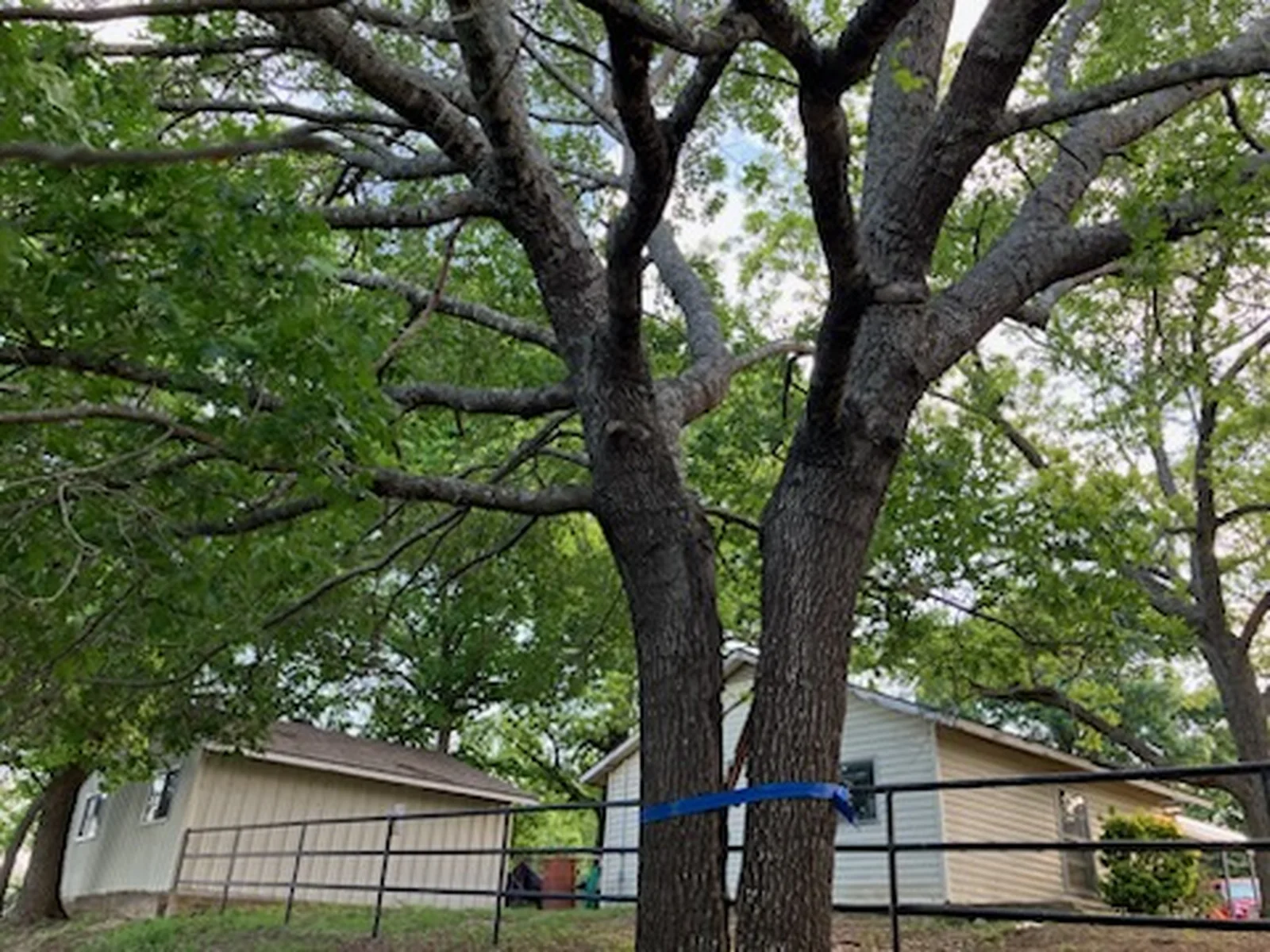
This one was a different challenge. Two big stems coming up off one base, and the union where they met had started to come apart.
He didn’t wait around to find out how fast it was moving. He ran a ratchet strap around both trunks, cinched it down, and called us just as quick as he strapped it.
It was weight.
When a union has already started separating, every pound hanging out at the ends of those limbs is working against it, and a windy afternoon makes it worse. The ends of a limb have the most leverage on the trunk, so that is where the load comes off first.
So the first thing that tree got was a tip weight reduction. Length and weight taken off the ends on both stems, right then, to cut the leverage pulling that split open. That part could not wait.
Once the load was off it, we could do the rest properly. We bolted through the split and set two cables up in the canopy.
Cables and brace rods do not repair a split. Nothing repairs a split. What a support system does is manage a defect, spreading the load so a tree can carry a problem it could not carry by itself.
Put steel in a tree that is still carrying too much weight and all you have done is give the failure a new place to start. That is why the reduction came first and the hardware came second.
Cabling and bracing have their own written standard, separate from pruning. It covers where cables go in the canopy, what hardware is acceptable, and the fact that a support system needs looking at again down the road rather than being installed and forgotten.
Source: ANSI A300 Part 3, Supplemental Support Systems, the national standard for cabling, bracing and guying.
Before the first cut, we told him what we thought. That tree was a good candidate for removal, and cabling a split like that one is a way to manage a defect, not a way to repair it. Support hardware buys a tree time. It does not put a union back together.
He wanted to try. It was his tree and his call. We tell you what the work will do, you make the decision, and we do the work you asked. That’s The Arborwise™ Way.
So we did. That tree is still standing.
It’s carrying a defect it will always carry, and a support system like that one gets looked at again down the road rather than installed and forgotten. But it’s still there, and he’s the one who decided it would be.
Most of the time, on a tree like that one, yes. But every split is its own animal and tree work changes in a hurry. What makes sense on your tree depends on the species, where the union sits, how much canopy is hanging over what, and what is underneath it.
That is a good bit of what you are actually hiring, 20+ years of combined experience navigating tricky tree situations, and somebody who will tell you honestly whether a tree is worth saving before you spend a dollar trying to save it.
He earned a paragraph here.
Our Stihl drill was built for exactly this, boring through a trunk for brace rods. Cost about eight hundred dollars. Kept quitting on us anyway, right there in the bed of the truck. He watched that happen.
When the job was done, he handed us a Milwaukee Hole Hawg. We still use it.
That tree mattered to him, and he did the two things that actually mattered. He acted the same day he saw the problem, and he got somebody out before he tried to solve it himself. He heard us out, made his own call, and we went and did it.
If you have a tree with two stems coming off one trunk, and you have noticed a crack starting where they meet, send us a photo. That is the one not to sit on. There is more on how we handle these on our cabling and bracing page.
Call, text, or send us a couple photos. We always try to answer our own phone, and estimates are always free.