Core Service
Tree Removal
Tree removals done right, the Arborwise™ Way! Proper PPE and a crew that has carefully plotted exactly where this tree was supposed to hit the ground, and it did!
Learn more about tree removal
Structural support for split leaders and heavy limbs, so a valuable tree can stay standing instead of coming down.
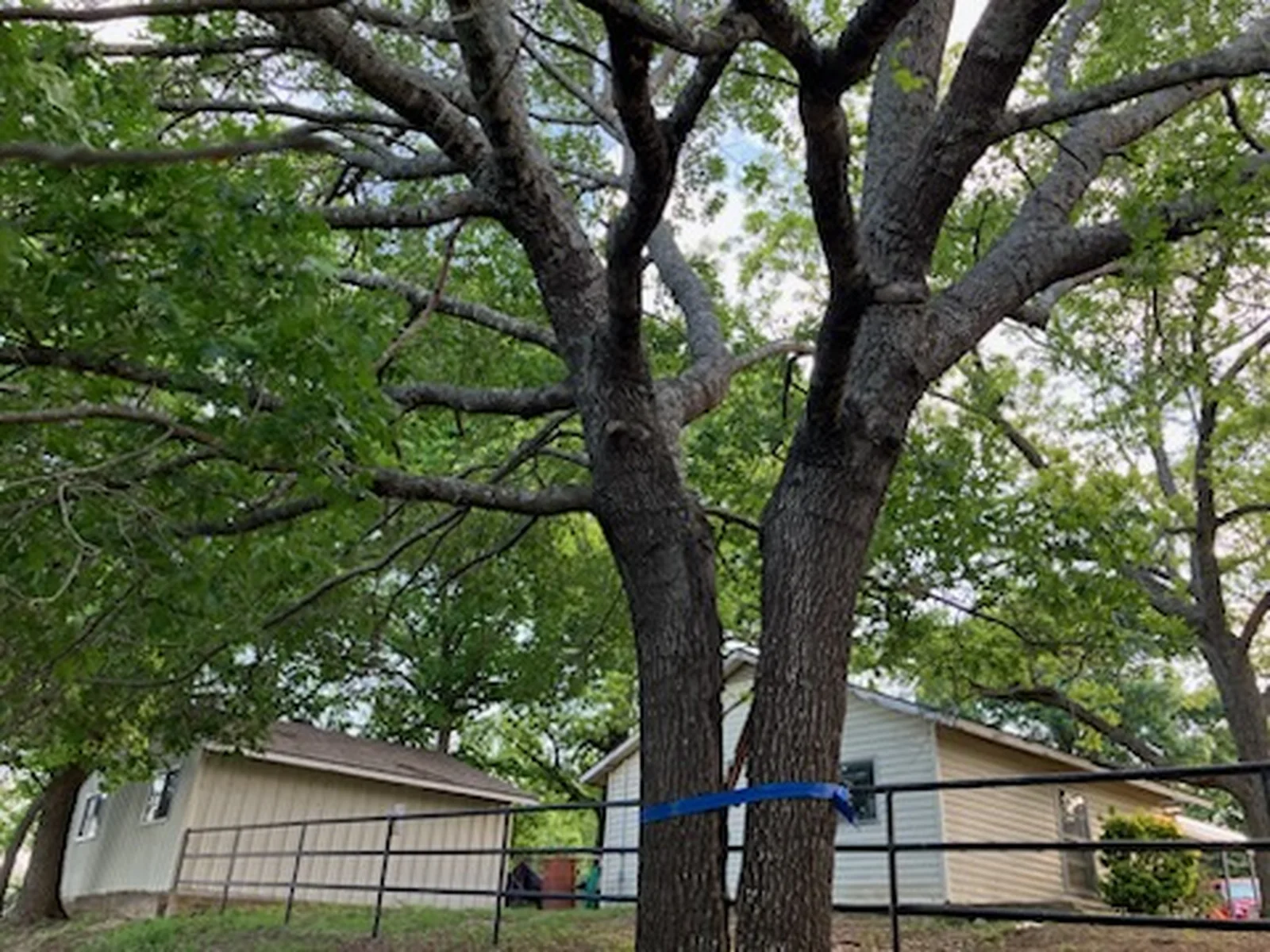
Not every structurally compromised tree needs to be removed. A mature shade tree with a split leader or a heavy horizontal limb is often worth saving, and cabling and bracing is how you save it.
Cables are installed high in the canopy to limit how far weak unions can move in wind. Bracing rods go through the union itself to hold a split together. Both are hardware decisions that depend on species, union geometry, decay, and what is underneath the tree, which is exactly why an ISA Certified Arborist on staff should be the one specifying it. Done right, a system buys a tree decades. Done wrong, it hides a hazard and gives the owner false confidence.
Source: ANSI A300 Part 3, Supplemental Support Systems, the national standard for cabling, bracing and guying. It covers where cables belong in the canopy, what hardware is acceptable, and the fact that a support system gets looked at again down the road rather than installed and forgotten.
Two trunks off one base, and a seam running up between them. Before we put cables in a tree like this, we want to look at where the two trunks meet and see if there is any rot in there, and how much. If that fork is solid, a cable usually does a lot of good. If it is rotted out, hardware is not likely to hold it, and we would rather tell you that than take your money for one.
Around here it comes down to three. Oaks, cedar elm, and Bradford pear. Those are the trees we end up cabling, and they get there two very different ways.
Both of them like to fork. Two stems come up off one base, close to the same size, and neither one ever wins. That is the shape we get called out to look at most often, in the established parts of Farmersville, Van Alstyne, Sherman and Bonham where those trees have had decades to put on size.
A fork by itself is not a problem. It turns into one when bark gets trapped down in the seam instead of wood growing across it. That is called included bark, and it means the two stems are pressed against each other rather than actually joined. From the ground it can look like nothing at all.
 Source: Texas A&M Forest Service, Pruning Young Trees, on codominant stems weakening a tree’s structure, and on narrow attachments trapping bark between them, which weakens the connection and can cause the limb to fail as the tree grows.
Different story entirely. No Bradford pear got big and forked over sixty years. It got planted. It was a popular pick around here for a stretch, and it went into a lot of front yards on the newer streets in Anna, Melissa, Celina and Princeton. Those trees are growing into their cabling season right about now. The tree is not new. The timing is.
 Source: Texas A&M AgriLife, Deciding when to remove a tree (2020), quoting a Texas A&M Forest Service staff forester: Bradford pear has a weak branch structure and can break apart in less than 20 years.
It’s not just us saying it. Four states have moved to stop new ones going in the ground. Ohio made it illegal to sell, grow or plant Callery pear, the species Bradford came from, and South Carolina, Pennsylvania and Kansas have followed with bans or restrictions of their own. Texas has not, and none of that reaches a tree already standing in your yard. Nobody has to take a tree out because of a law in Ohio. We bring it up because when that many state agencies land in the same place on one tree, it’s worth knowing before you spend money on hardware for it.
Source: NC State Extension, Callery Pear: Bradford Pear, Other Varieties, and Their Invasive Offspring, on Ohio, South Carolina, Pennsylvania and Kansas enacting bans between 2021 and 2024.
So we will tell you straight on these. We usually recommend taking a Bradford pear out rather than putting hardware in one, and that lines up with what Texas A&M says about them. That recommendation assumes you have other trees, though. On plenty of streets around here every tree in the front yard is a Bradford pear, and removing it leaves a yard with no tree in it at all. When it is the primary tree on the property and you would rather keep it, we will do our best to keep it standing, and we will be honest with you about what a support system buys a tree like that one. It is your yard and your call. Tell us which way you want to go and we will take care of it.
A photo tells us whether it is worth coming out to look. Whether hardware is the right answer for your tree is a walkthrough, because no two forks are built the same and tree work changes in a hurry. Most of the time on these three the conversation goes one of two ways. Take the weight down and put in a support system, or take the tree down.
That call is a good bit of what you are actually hiring, 20+ years of combined experience navigating tricky tree situations. We will tell you plainly what each option would likely do to the tree. After that it is your tree and your call, and we will do the work you ask for.
Usually yes, and often by a lot, especially when you factor in what a mature shade tree adds to a property. It also preserves shade you cannot buy back for thirty years.
A properly installed system lasts many years, but it needs periodic inspection. Trees grow, hardware loads change, and a cable that was right five years ago may need adjusting.
No, and that is the honest answer. If decay is advanced or the union is already failing, hardware just delays the inevitable and can make failure less predictable. We will tell you when removal is the right call.
No. Since 2019 we have never charged a customer more than we quoted. If a job takes longer than we figured, that is our miss, not your bill. The only time your number changes is when you say so. If you decide you want more done while we are there, that is a separate line, and we agree on it before anyone touches it. And if we find something the estimate could not have accounted for, you hear about it that day, before any work continues.
“Knowledgeable, skilled, kind and respectful.”
Was worried about cost at first, but said the care taken with her trees, yard and cleanup made it worth it.
“Amazing service, 5/5 no notes.”
The problem got handled and the crew was easy to be around.
“They always do a fantastic job.”
Called out Greg and the team for a smooth, professional process and competitive pricing.
Tree removals done right, the Arborwise™ Way! Proper PPE and a crew that has carefully plotted exactly where this tree was supposed to hit the ground, and it did!
Learn more about tree removalStructural pruning, canopy thinning, and clearance work done with proper collar cuts, never topping.
Learn more about tree trimming and pruningThe right tree in the right spot, planted at the right depth. Planting too deep is one of the leading reasons new trees die. Get that right and it usually takes off from there.
Source: Texas A&M Forest Service, Planting, on planting too deep as a leading cause of death in newly planted trees.
Also available: stump grinding, plus storm damage response for genuine emergencies.
Call, text, or send us a couple photos of the tree. We always try to answer our own phone, and estimates are always free.