
Established 2019
Rapid growth, new construction trees, and established oaks along older roads and properties.
Also available: stump grinding, plus storm damage response for genuine emergencies.
Melissa has changed fast, and its trees are a mix of brand new landscape installs and mature trees left standing around new construction.
The new neighborhoods have the same challenges we see across growing Collin County, buried root flares, trees staked too long, and species planted where their mature size was never considered. The older properties have the opposite problem, mature oaks and pecans that suddenly have new houses, drives, and grading close to their roots. Both need attention for completely different reasons.
Blackland Prairie clay runs through most of this region, and it behaves in a way that catches people off guard. It holds water tight through a wet spell and then cracks hard in a drought, and that swelling and shrinking works on a root plate year after year. It does that underneath, over years, where nobody can see it, which is why we look at the root flare and the lean before anything else. We inspect the whole tree, root flare included, before we recommend anything.
Source: USDA NRCS Official Series Description, Houston Black series, the Texas state soil, and the Soil Science Society of America on smectite clay, which swells as it takes water between its crystal layers and shrinks as it dries.
Whatever your Melissa property needs, the work gets done the same way, to the same standard, with the same free written estimate. We will also tell you when a tree does not need work yet, which is not the fastest way to run a tree company but it is the reason people call us back.
Melissa has a lot of mature trees that were standing long before the house next to them was. Builders leave the good ones when they can, and homeowners are glad they did. What almost nobody gets told is that damage from a build usually does not show up for three to seven years.
A tree's roots are not down deep. Most of the ones that matter sit in the top eighteen inches of soil and spread at least as far out as the branches do, often further. Everything that happened in that zone during construction happened to the tree.
COMPACTION. Trucks, trailers and stacked material press the soil closed. Roots need air in the soil the same way they need water, and compacted clay in this area is very slow to recover on its own.
GRADE CHANGE. Even a few inches of fill spread over the roots to level a yard can smother them. Soil piled against the trunk is worse, because bark that stays wet starts to rot.
TRENCHING. A utility line, a sprinkler run or a driveway cut through one side of the root zone can take out a large share of the anchoring roots on that side. The tree usually looks completely normal afterward, which is the whole problem.
WHAT IT LOOKS LIKE WHEN IT FINALLY SHOWS. Usually thinner leaves at the top of the tree first, then dead twigs at the branch tips, then whole limbs. By the time it reads as a problem, the cause is years behind you.
None of that means a tree that went through a build is finished. Plenty of them are fine and plenty more can be helped, as long as somebody looks before the decline gets far along. If your house is under about ten years old and there is a big tree next to it that predates the house, that is the one worth having looked at. That walk is free.
EMERALD ASH BORER. It's confirmed in Collin County, and the county is under quarantine, which restricts moving ash wood and nursery stock out of it. Ash is one of the most common trees we work on out here, so if you have one in Melissa, that's worth knowing now rather than later. Usually the first sign is the top of the canopy thinning out, then shoots coming out low on the trunk, and by the time you can see it from the driveway the tree has been fighting it a while. Whether it's worth treating, and what that would take, depends on how far along it is. That's a conversation to have standing in front of the tree, not over the phone. Walking your ash and telling you which one you have costs you nothing.
Source:
 Texas A&M Forest Service, Emerald Ash Borer, 40 confirmed Texas counties as of June 2026. Quarantines are set by the Texas Department of Agriculture.
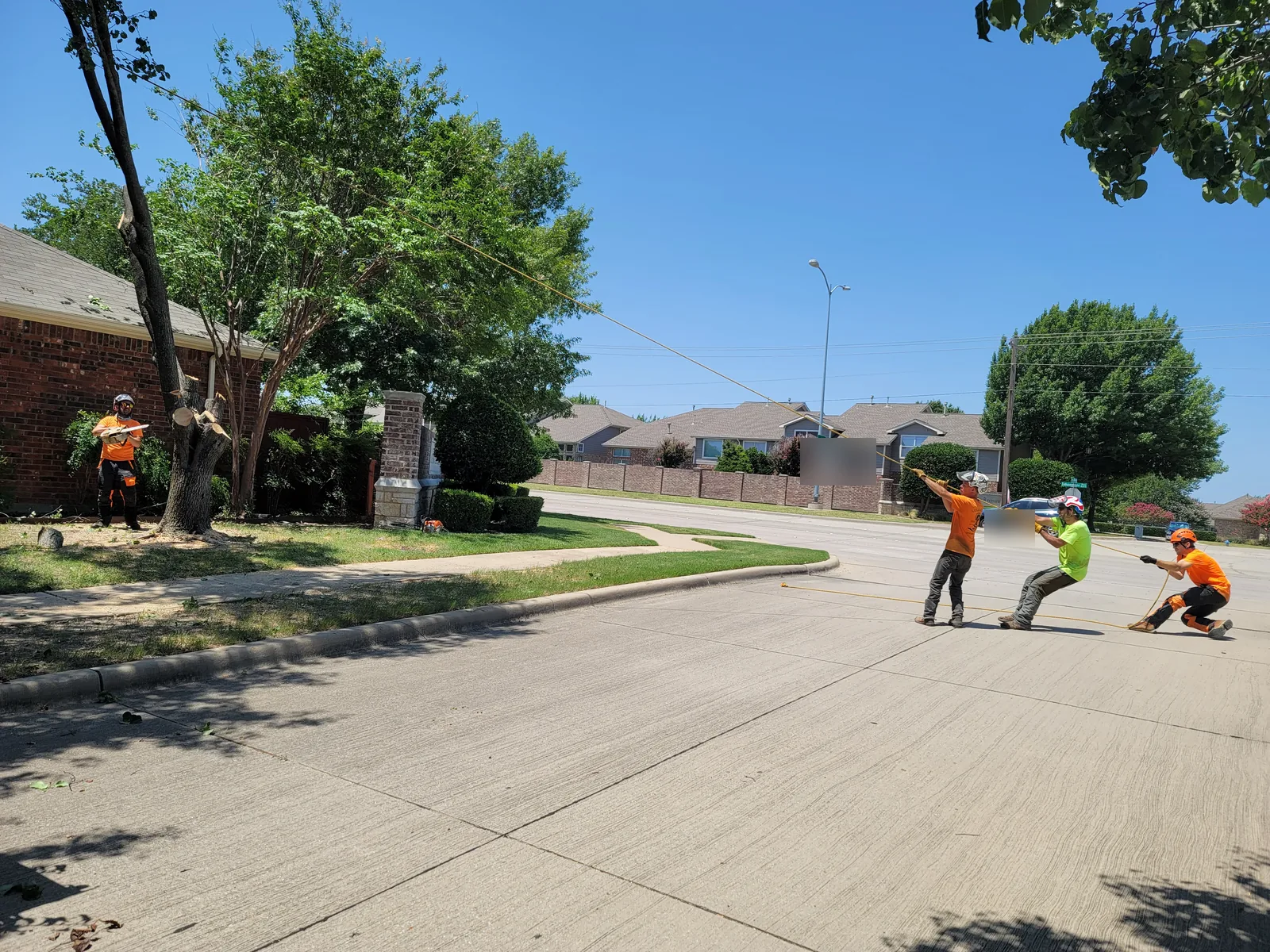
Tree removals done right, the Arborwise™ Way! Proper PPE and a crew that has carefully plotted exactly where this tree was supposed to hit the ground, and it did!
Learn more about tree removalStructural pruning, canopy thinning, and clearance work done with proper collar cuts, never topping.
Learn more about tree trimming and pruningStructural support for split leaders and heavy limbs, so that tree usually sticks around for years to come.
Learn more about tree cabling and bracingThe right tree in the right spot, planted at the right depth. Planting too deep is one of the leading reasons new trees die. Get that right and it usually takes off from there.
Source: Texas A&M Forest Service, Planting, on planting too deep as a leading cause of death in newly planted trees.

Reviews from clients across our North Texas service area.
“Knowledgeable, skilled, kind and respectful.”
Was worried about cost at first, but said the care taken with her trees, yard and cleanup made it worth it.
“Amazing service, 5/5 no notes.”
The problem got handled and the crew was easy to be around.
“They always do a fantastic job.”
Called out Greg and the team for a smooth, professional process and competitive pricing.
The same six standards on every job, whether it is one limb or a full removal.
Safety is not optional on an Arborwise™ job. Required PPE, proper rigging, controlled cuts, and a crew that speaks up the moment something looks unsafe. No job is worth someone getting hurt.
Doing it right sometimes takes longer. We do not rush an unsafe cut, skip PPE, or leave a bad cleanup because it is faster. Good tree work is deliberate.
Every yard belongs to someone who trusted us to be there. We protect your driveway, your landscaping, and your trees with the right cuts and the right decisions, not just the fastest ones.
We keep our equipment maintained, our loads secure, and we pick up the small sticks most crews leave behind. We leave every property better than we found it.
Arborwise™ is a crew, not a collection of individuals. We communicate, watch for hazards, and speak up for one another on every single job.
The Arborwise™ Way is not always the fastest way. It is the right way, even when it takes longer, and even when nobody is watching.
Melissa is a scheduled service area for us, not a place we visit when we happen to be nearby. We will tell you honestly if we are backed up.
Estimates are free, wherever you are in our service area. Drive time is one of the things that goes into pricing any job, so it is already accounted for in the number we hand you rather than added on afterward. And that number is the price. Since 2019 we have never charged a customer more than we quoted.
Yes. We handle scheduled maintenance, hazard assessment, and planned replacement on a budget cycle, and we are used to coordinating with boards and managers.
No. Since 2019 we have never charged a customer more than we quoted. If a job takes longer than we figured, that is our miss, not your bill. The only time your number changes is when you say so. If you decide you want more done while we are there, that is a separate line, and we agree on it before anyone touches it. And if we find something the estimate could not have accounted for, you hear about it that day, before any work continues.
Call, text, or send us a couple photos of the tree. We always try to answer our own phone, and estimates are always free.