Established 2019
Hunt County held its first court under the oaks at St. John and Bourland, before there was even a courthouse to hold court. The trees were here before the buildings, and a good many of them are still out there.
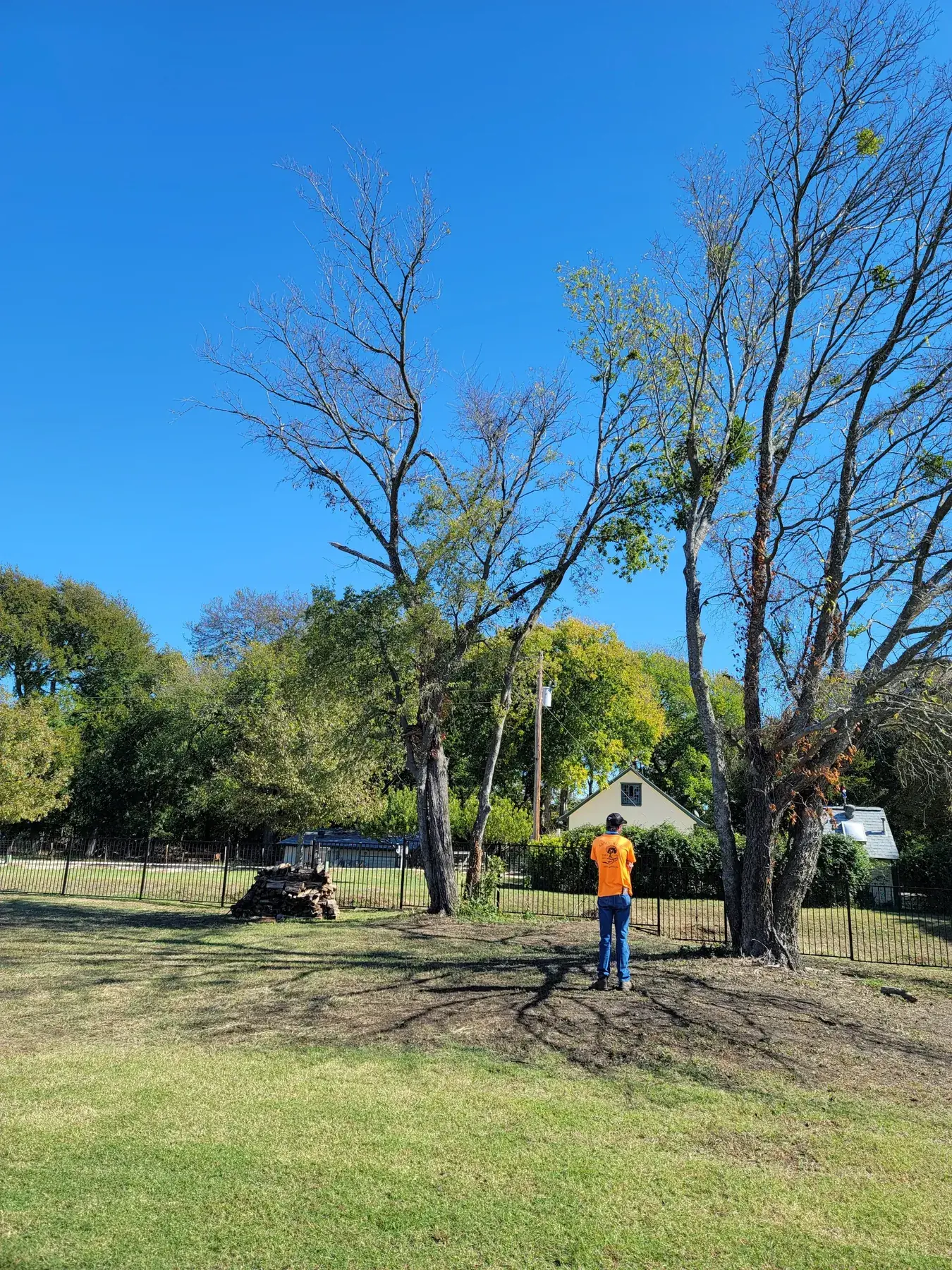
When Hunt County was created in 1846 and Greenville was named the county seat, court sessions were held under oak trees at a corner downtown, because there was no courthouse yet.
We like that detail more than most people would. It is a decent reminder that trees were doing real work here before the buildings showed up, and a lot of them are still at it. Greenville went on to become a cotton and railroad town, and today downtown carries ten Texas Historical Markers and four buildings on the National Register. Old town, old money in the ground, and old trees.
That history is exactly what makes tree work here different from a new build suburb. In the older neighborhoods it's usually oaks first, with plenty of ash and elm mixed in, and a lot of them have been standing through decades of North Texas weather. Storm scars healed over. Old topping cuts from decades ago that pushed out weak regrowth. Cavities and included bark at forks that formed long before anyone was watching. These are not throwaway trees. A mature shade tree in front of a historic home is part of the property's value and part of the street, and the right answer is almost never to take it down because it looks intimidating.
It is also almost never to top it. Topping a tree removes the leaves it feeds itself with and forces out a mass of weakly attached shoots that are far more likely to fail than what you cut off. If a big tree near your house worries you, the honest options are a real assessment, targeted structural pruning, cabling or bracing to support a weak union, or removal when the tree is genuinely past saving. We will tell you which one you are looking at.
Greenville was carved out of the blackland prairie, and where the ground is that heavy black clay, it swells when it rains and cracks hard in a drought. That constant movement works on a root plate year after year. It does that underneath, over years, where nobody can see it. We inspect the whole tree, root flare included, before we recommend anything, and we will tell you when a tree does not need work yet, which is not the fastest road to success for a tree company but it is the reason people continue to have us back every year. The right work, done right.
Source: the City of Greenville's downtown heritage guide, on court sessions under the oaks in 1846, the town's blackland prairie start, and the ten Texas Historical Markers and four National Register buildings downtown.
We were finishing a removal out here one day after a stretch of rain. The tree had to come out and the forecast wasn't getting any better, so we got it done. Pulling out, the ground had other plans. The trailer slid off into the ditch, and when we tried to get it back out, the truck got stuck right along with it.
The wrecker said two and a half to three hours. So we walked up to the Dollar General to make some more calls, and got to talking with the cashier. She knew who Arborwise was. She said, well, let me call somebody. That somebody called somebody else, and so on down the line, and somewhere between fifteen minutes and half an hour later a man showed up and pulled us out.
He didn't want anything for it. We made him take something anyway, along with a card, and told him that any time he needs tree work, he calls us and he'll be taken care of.
Greenville is just good people. It's the same kind of place as Farmersville, and it's a big part of why we like working out here.
Greenville called itself the cotton capital of the world, and the city's own history backs that up, with the world's largest cotton compress and world records in 1911 and 1912.
The black clay that grew it came with a problem. Cotton root rot, also called Texas root rot, is a soil fungus that favors alkaline clay. USDA's soil survey says it's prevalent across most of Houston Black clay, the signature soil of the Blackland Prairie, and Texas A&M set up its Blackland station at Temple in 1909 with special attention on controlling it.
It isn't only a cotton problem. Texas A&M lists shade, fruit and nut trees among the plants it matters for. It usually shows up between June and September, once the soil warms to about 82 degrees, and the first sign is often a slight yellowing or bronzing in the leaves.
Plenty of other things look like that from the street, summer drought most of all, and the soil here can change from one street to the next. Sorting one cause from another is where 20+ years of combined experience earns its keep, so if a tree went downhill fast this summer, send us a photo or ask Annie before you spend money on the wrong fix.
Sources: the City of Greenville's downtown heritage guide on the cotton compress; Texas A&M Plant Disease Handbook on cotton root rot; USDA NRCS description of Houston Black clay; Texas A&M Blackland Research Center history.
Tree removals done right, the Arborwise™ Way! Proper PPE and a crew that has carefully plotted exactly where this tree was supposed to hit the ground, and it did!
Learn more about tree removalStructural pruning, canopy thinning, and clearance work done with proper collar cuts, never topping.
Learn more about tree trimming and pruningStructural support for split leaders and heavy limbs, so that tree usually sticks around for years to come.
Learn more about tree cabling and bracingThe right tree in the right spot, planted at the right depth. Planting too deep is one of the leading reasons new trees die. Get that right and it usually takes off from there.
 Source: Texas A&M Forest Service, Planting, on planting too deep as a leading cause of death in newly planted trees.
Also available: stump grinding, plus storm damage response for genuine emergencies.
Reviews from clients across our North Texas service area.
“Knowledgeable, skilled, kind and respectful.”
Was worried about cost at first, but said the care taken with her trees, yard and cleanup made it worth it.
“Amazing service, 5/5 no notes.”
The problem got handled and the crew was easy to be around.
“They always do a fantastic job.”
Called out Greg and the team for a smooth, professional process and competitive pricing.
The same six standards on every job, whether it is one limb or a full removal.
Safety is not optional on an Arborwise™ job. Required PPE, proper rigging, controlled cuts, and a crew that speaks up the moment something looks unsafe. No job is worth someone getting hurt.
Doing it right sometimes takes longer. We do not rush an unsafe cut, skip PPE, or leave a bad cleanup because it is faster. Good tree work is deliberate.
Every yard belongs to someone who trusted us to be there. We protect your driveway, your landscaping, and your trees with the right cuts and the right decisions, not just the fastest ones.
We keep our equipment maintained, our loads secure, and we pick up the small sticks most crews leave behind. We leave every property better than we found it.
Arborwise™ is a crew, not a collection of individuals. We communicate, watch for hazards, and speak up for one another on every single job.
The Arborwise™ Way is not always the fastest way. It is the right way, even when it takes longer, and even when nobody is watching.
Greenville is a scheduled service area for us, not a place we visit when we happen to be nearby. We will tell you honestly if we are backed up.
Estimates are free, wherever you are in our service area. Drive time is one of the things that goes into pricing any job, so it is already accounted for in the number we hand you rather than added on afterward. And that number is the price. Since 2019 we have never charged a customer more than we quoted.
Often, yes. Age alone is not a reason to remove a tree. What matters is the structure, how much holding wood is left, and what would be underneath it if part of it failed. A large old tree can frequently be kept with targeted pruning to reduce tip weight, or with cabling and bracing to support a weak union. Removal is the answer when the tree is genuinely past saving, and we will say so plainly when that is the case.
No. Topping removes the foliage the tree feeds itself with and forces out a mass of fast growing shoots that are attached far more weakly than the limbs that were cut off. It creates the hazard it claims to fix, and it does permanent damage. Proper reduction pruning at the right cuts gets you the safety without the harm.
Yes. We handle scheduled maintenance, hazard assessment, and planned replacement on a budget cycle, and we are used to coordinating with boards and managers.
No. Since 2019 we have never charged a customer more than we quoted. If a job takes longer than we figured, that is our miss, not your bill. The only time your number changes is when you say so. If you decide you want more done while we are there, that is a separate line, and we agree on it before anyone touches it. And if we find something the estimate could not have accounted for, you hear about it that day, before any work continues.
Call, text, or send us a couple photos of the tree. We always try to answer our own phone, and estimates are always free.