
Established 2019
We have worked in Howe since Arborwise started in 2019, and we know what the 75 corridor is about to do to this town and to the trees along it.
For the whole time we have been in business, Howe has been a quiet stop on US 75 between Van Alstyne and Sherman. That is changing, and it is changing fast.
TxDOT is widening US 75 to six main lanes from the Collin County line up to FM 902, a 9.8 mile job that also reconstructs the County Line Road bridge and adds a new u-turn bridge in Howe south of Hall Cemetery Road. The frontage roads through town were converted to one-way traffic on February 4, 2026.
Alongside that, a 180 acre tract at FM 902 and Bennett Road sold in May 2026 for a mixed use retail and residential community. The family that sold it had held that ground for 140 years, which tells you about as much as any acreage figure does. Cottonwood, the master planned community in Howe ISD, was bought for development in early 2023.
West of the highway, Noble Ridge is going in now, around 700 homes when it is finished, named for sitting on the highest point in Grayson County. That last part matters more than it sounds. New trees on an exposed ridge, on ground that was graded a year ago, with no established canopy around them yet, have a harder job than the same tree planted down in town.
Further north, the Texas Instruments semiconductor expansion in Sherman is pulling rooftops into every town on this corridor.
Source: Texas Department of Transportation, Paris District project releases, on the US 75 widening, the County Line Road bridge, the Howe u-turn bridge and the February 4, 2026 frontage road conversion. Younger Partners press release, May 19, 2026, and The Real Deal, on the 180 acre sale at FM 902 and Bennett Road by the Hightower Family Trust. Walton Global, February 2023, on the sale of 680 acres to Centurion American for Cottonwood. Rockhill Capital and Investments, November 2024, carried by KTEN, on Noble Ridge, its roughly 700 homes and its location on the highest point in Grayson County.
All of that is good for Howe. It is hard on Howe's trees.
When wind leaves fresh damage in an older tree, our storm damage guide shows what is worth treating as urgent.
Mature trees do not complain about root damage when it happens. Trenching, regrading, and heavy equipment parked over a root zone cut and compact roots that the tree needed, and the tree carries on looking fine for two or three seasons before it tells you. Thin canopy. Leaves dropping early. Deadwood appearing in the upper crown. A flush of small shoots low on the trunk. If road work, utility work, or construction has happened near a big tree on your place in the last few years, that tree is worth a look even if it seems healthy.
The pecans out here are their own subject. Every late summer we get calls about the white webbed nests that show up at the ends of pecan branches, and most of those calls end with us telling the owner their tree is fine. Fall webworm looks alarming and is almost entirely cosmetic on an established pecan. It is worth knowing the difference before somebody sells you a treatment you do not need.
Source:
 Texas A&M Forest Service, Fall Webworm, which describes it as mainly affecting the appearance of trees and more a nuisance than a threat to tree health. Texas A&M AgriLife notes that by fall the leaves are becoming less functional and will drop soon regardless, so late season defoliation costs an established tree little.
We also do a fair amount of cleanup after utility line clearance around here. Line crews are there to protect the conductors, not to leave you a balanced tree, and what they leave behind is often one sided with stubs that will not seal. That can usually be corrected with proper cuts rather than removal, and it is a much better answer than a homeowner going up a ladder with a saw, which is how one of our Howe jobs started.
Underneath all of it is Blackland Prairie clay, which swells when it rains and cracks hard in a drought. That constant movement works on a root plate year after year. It does that underneath, over years, where nobody can see it, which is one reason a tree that has started leaning is usually worth having looked at rather than guessed about. We inspect the whole tree, root flare included, before we recommend anything, and we will tell you when a tree does not need work yet, which is not the fastest road to success for a tree company but it is the reason people continue to have us back every year. The right work, done right.
EMERALD ASH BORER. It's confirmed in Grayson County, and the county is under quarantine, which restricts moving ash wood and nursery stock out of it. If you have an ash tree in Howe, that's worth knowing now rather than later. Usually the first sign is the top of the canopy thinning out, then shoots coming out low on the trunk, and by the time you can see it from the driveway the tree has been fighting it a while. Whether it's worth treating, and what that would take, depends on how far along it is. That's a conversation to have standing in front of the tree, not over the phone. Walking your ash and telling you which one you have costs you nothing.
Source: Texas A&M Forest Service, Emerald Ash Borer, 40 confirmed Texas counties as of June 2026. Quarantines are set by the Texas Department of Agriculture.
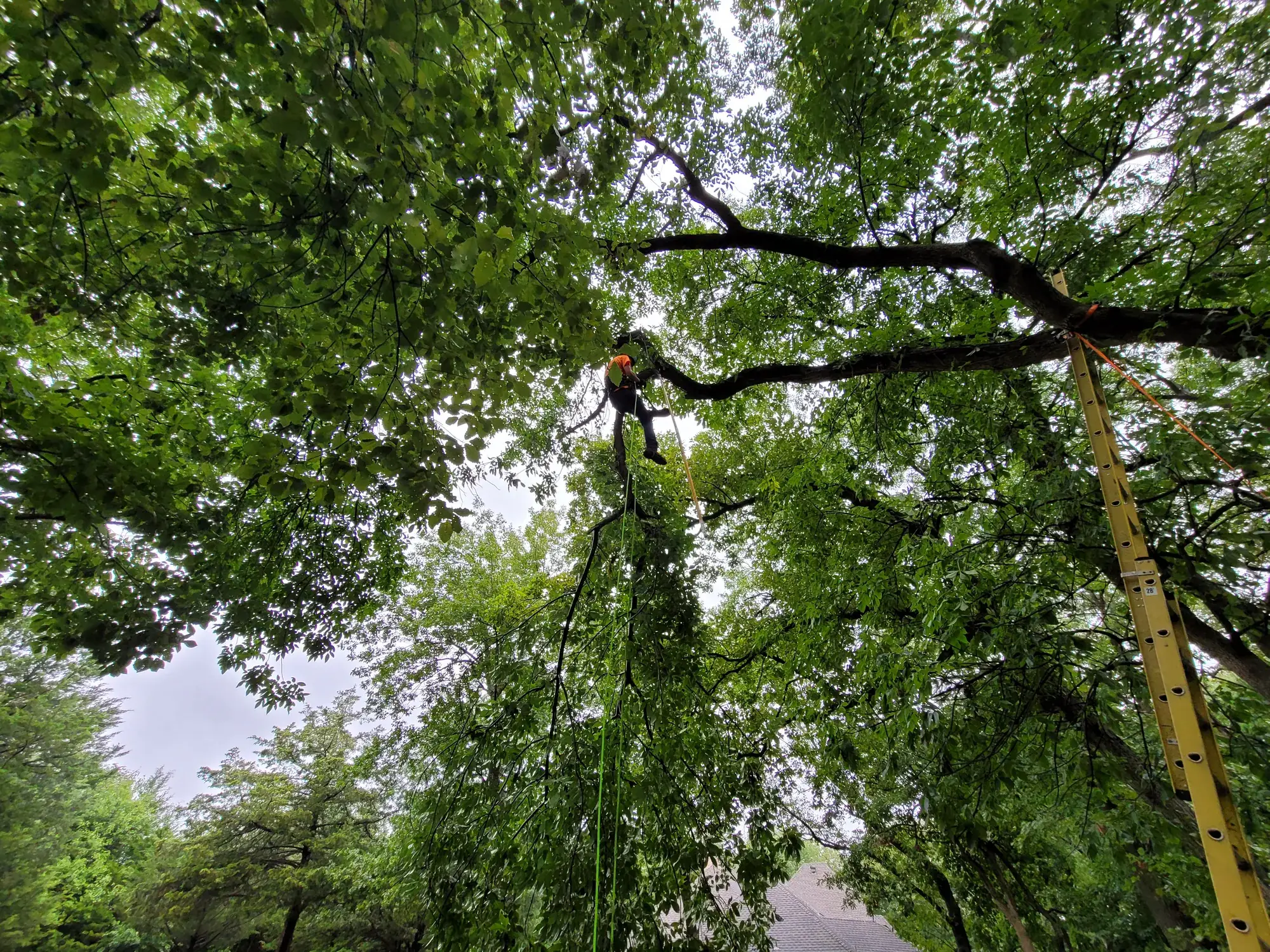
Tree removals done right, the Arborwise™ Way! Proper PPE and a crew that has carefully plotted exactly where this tree was supposed to hit the ground, and it did!
Learn more about tree removalStructural pruning, canopy thinning, and clearance work done with proper collar cuts, never topping.
Learn more about tree trimming and pruningStructural support for split leaders and heavy limbs, so that tree usually sticks around for years to come.
Learn more about tree cabling and bracingThe right tree in the right spot, planted at the right depth. Planting too deep is one of the leading reasons new trees die. Get that right and it usually takes off from there.
Source: Texas A&M Forest Service, Planting, on planting too deep as a leading cause of death in newly planted trees.
Also available: stump grinding, plus storm damage response for genuine emergencies.

Reviews from clients across our North Texas service area.
“Knowledgeable, skilled, kind and respectful.”
Was worried about cost at first, but said the care taken with her trees, yard and cleanup made it worth it.
“Amazing service, 5/5 no notes.”
The problem got handled and the crew was easy to be around.
“They always do a fantastic job.”
Called out Greg and the team for a smooth, professional process and competitive pricing.
Six standards, on every job in Howe, whether it is one limb or a full removal.
Safety is not optional on an Arborwise™ job. Required PPE, proper rigging, controlled cuts, and a crew that speaks up the moment something looks unsafe. No job is worth someone getting hurt.
Doing it right sometimes takes longer. We do not rush an unsafe cut, skip PPE, or leave a bad cleanup because it is faster. Good tree work is deliberate.
Every yard belongs to someone who trusted us to be there. We protect your driveway, your landscaping, and your trees with the right cuts and the right decisions, not just the fastest ones.
We keep our equipment maintained, our loads secure, and we pick up the small sticks most crews leave behind. We leave every property better than we found it.
Arborwise™ is a crew, not a collection of individuals. We communicate, watch for hazards, and speak up for one another on every single job.
The Arborwise™ Way is not always the fastest way. It is the right way, even when it takes longer, and even when nobody is watching.
Howe is a scheduled service area for us and has been since Arborwise started in 2019, not a place we visit when we happen to be nearby. We will tell you honestly if we are backed up.
Estimates are free, wherever you are in our service area. Drive time is one of the things that goes into pricing any job, so it is already accounted for in the number we hand you rather than added on afterward. And that number is the price. Since 2019 we have never charged a customer more than we quoted.
Almost certainly not. That is fall webworm, and on an established pecan it is a cosmetic problem rather than a health threat. The tree drops those leaves shortly afterward anyway. Small nests within reach can be pruned out, and a heavy infestation on a young or already stressed tree is worth looking at, but a mature pecan does not need spraying for it. If someone is selling you a treatment for webworm, get a second opinion first.
Usually yes. Line clearance crews are there to protect the conductors, and they are not being paid to leave you a balanced tree. What gets left behind is often one sided, with stub cuts that will not seal and weak regrowth coming off them. Proper cuts can correct the structure and get the tree growing in the right direction again, and that is almost always a better answer than removal. It is also a much better answer than going up a ladder with a saw yourself.
It can, and the damage is usually underground where you cannot see it. Trenching, regrading and heavy equipment over the root zone all cut or compact roots, and a tree often looks fine for two or three seasons afterward. Warning signs are a thinner canopy than the year before, leaves dropping early, deadwood appearing up high, or small shoots flushing low on the trunk. If any of that started after work happened near the tree, have it looked at.
Yes. We handle scheduled maintenance, hazard assessment, and planned replacement on a budget cycle, and we are used to coordinating with boards and managers.
Call, text, or send us a couple photos of the tree. We always try to answer our own phone, and estimates are always free.