
Locally Owned Since 2019. Free Estimates Across North Texas.
Tree Guides · Tree Biology

Inside a Tree Trunk

A trunk looks like one solid piece of wood. It's really a set of layers, and each one has a job: protect, feed, carry water, grow, or hold the tree up.1 The part that keeps a tree alive is a thin band just under the bark. That one fact explains a lot about which tree injuries matter and which ones usually don't.

Updated October 2026. From the Arborwise™ team in Farmersville, Texas.

The living part of a tree is right under the bark. Tap a layer and I'll show you what it does!
Annie, the Arborwise owl
Trunk anatomy

Six layers, six jobs

Tap the drawing or a button. The drawing isn't to scale: the real cambium is microscopic.1

Start here

Tap any layer

Pick a layer on the drawing or one of the buttons, and I'll tell you what it does and what happens when it gets hurt.

Growth ring builder

Grow your own trunk

Each year the cambium lays a new ring of wood on the outside of the last one, right under the bark. A good year makes a wide ring. A dry year or a crowded spot makes a narrow one.1 Add some years and watch where the new wood goes.

12
years of rings
Cambium, where new wood forms This year's ring

Big rings mean the tree grew a lot that year. Little rings mean it didn't get to grow much.1

Rings laid down when a tree is young are often wider than later ones,9 so the trunk grows fast early and slows way down as it gets older. It never quite stops.

The drawing stays at one scale, so you're watching the trunk really grow: every new ring goes on the outside and the whole trunk gets wider. A seedling starts out tiny. Ring widths and the heartwood line here are for illustration. Real trees vary by species, soil, water and crowding.1

Why some injuries matter more

Hollow vs. girdled

Here's the part that surprises people. A tree can lose a lot of its center and keep living. A shallow wound that goes all the way around the trunk can kill it.

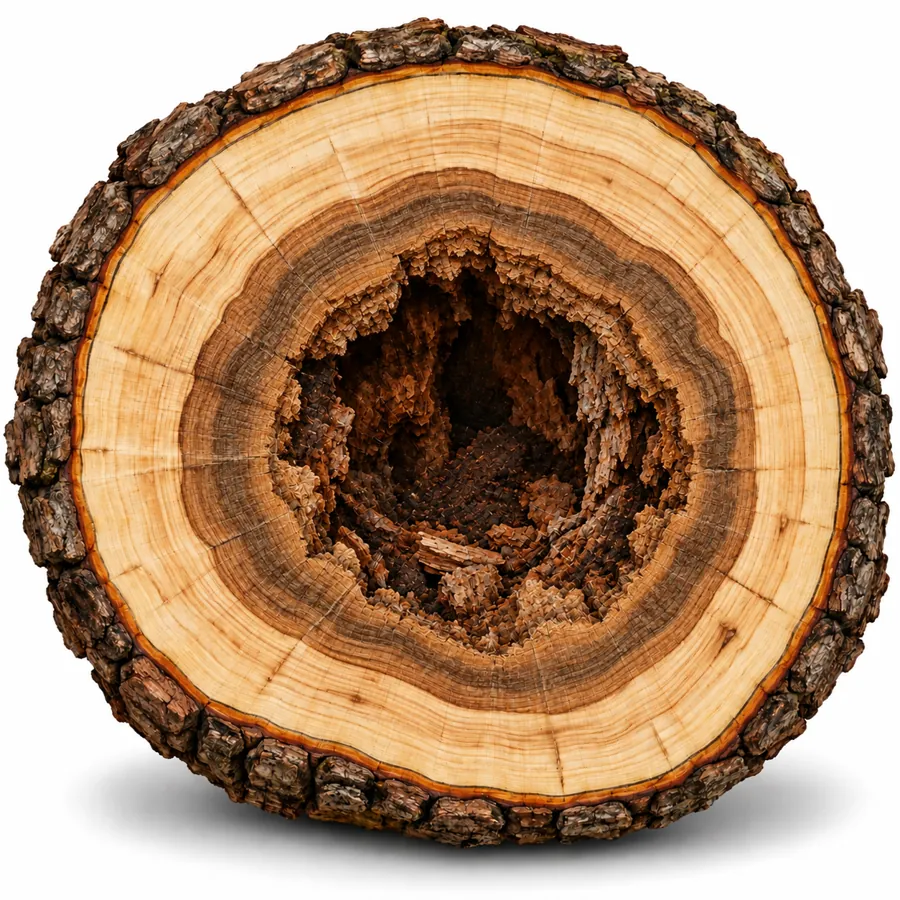
Illustration of a trunk cross-section with a decayed, hollow center and solid living wood around it
Illustration
Usually still alive

Hollow trunk

The center is heartwood, older wood that isn't moving water anymore.1 Trees can't heal. They wall decay off instead, and the cambium keeps building new wood on the outside every year.4 So a hollow tree can carry a full green canopy.

Alive isn't the same as safe. Decay can greatly reduce the strength of the wood it's in, and a large trunk cavity can leave a tree less able to stand up to a storm.5 How much risk a hollow carries usually comes down to how much sound wood is left around it, how big and exposed the canopy is, and whether the tree is healthy and upright.12
Drag to turn it
Illustration
Can kill the tree

Girdled trunk

The wood can look perfectly solid. But when the bark, inner bark and cambium are cut through all the way around the trunk, food from the leaves can't get down past the wound, and the tree can't grow new tissue across it.3

That's called girdling. The wound doesn't have to be deep. It just has to go all the way around.3 Turn the trunk above and you'll see it: the damage doesn't stop on one side.

Mowers and string trimmers

Bark knocked off at the base by equipment can seriously injure the tree's vascular system. A mulch circle around the trunk keeps machines off the bark.7

Buried root flares

When soil or mulch gets piled over the flare at the base of the trunk, roots can start circling and choking the tree, limiting water, nutrients and oxygen.6 A girdling root usually grows at or below the soil line,11 and it can wrap part of the way around the trunk or all the way. Sometimes more than one root does it at once.10 It usually happens unknowingly, and the effects run for years. See what a buried flare looks like

Old wounds and decay

An old wound is often where decay gets in.5 Wood decay can be hard to spot from the outside, so a tree can look normal while its structure is weaker than it appears.5

What it looks like in a real yard

From the street vs. up close

Drawings show what's going on inside. Here's what the same problems usually look like from the yard.

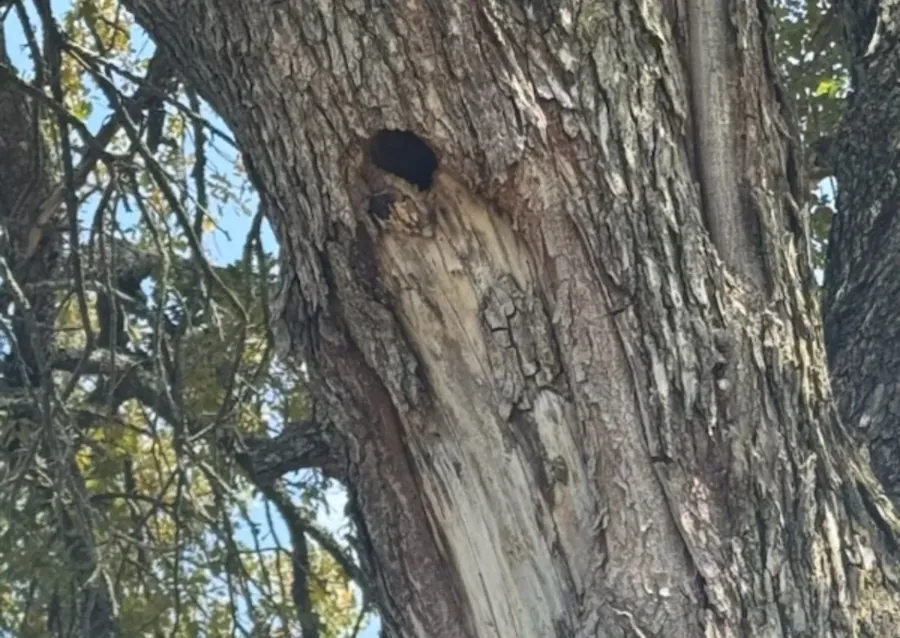
An open cavity high up on a large tree trunk, with a dark hole and weathered wood around it
Where a limb broke out. When a limb tears away, it usually strips a long run of bark down the trunk below it. That's the bare gray wood here. Decay then opened the hole right where the limb used to attach, and from the yard it's easy to miss.5
Real Arborwise™ North Texas tree work.
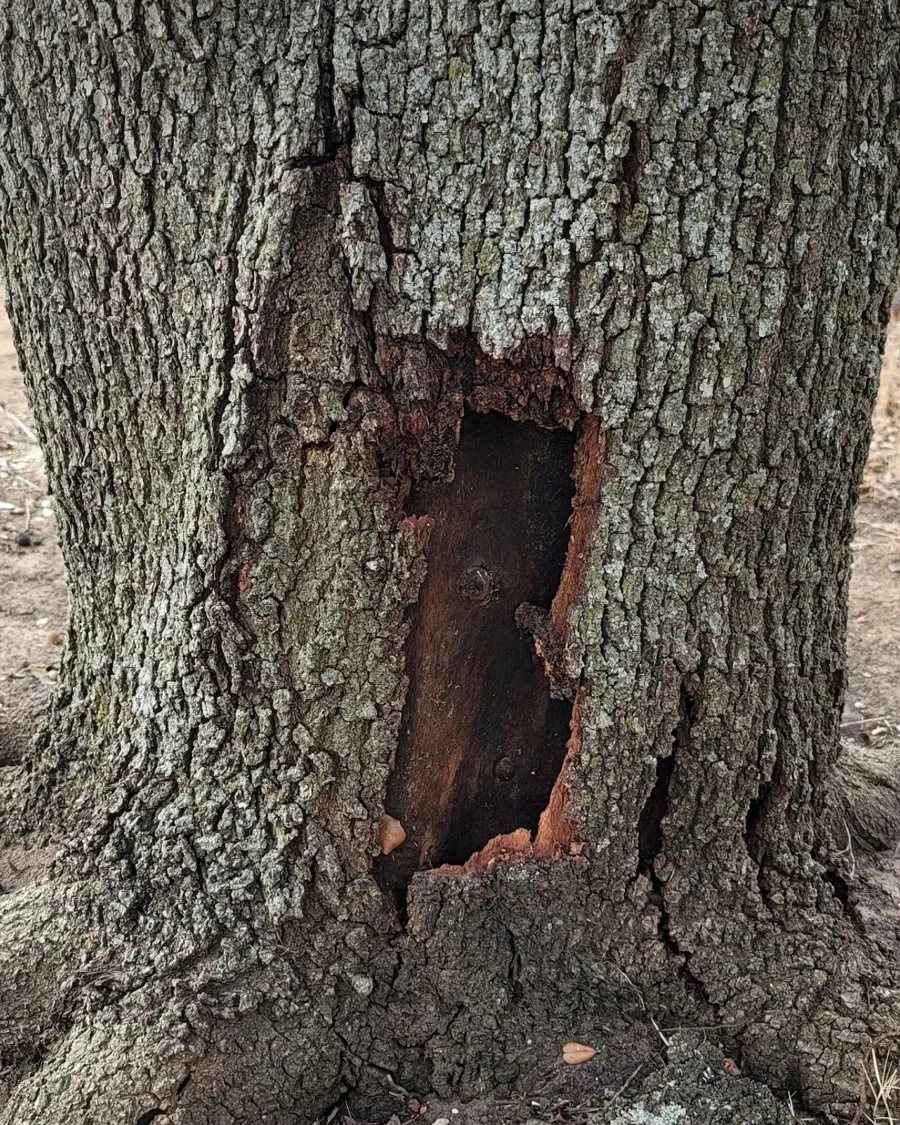
An opening at the base of a large oak trunk with dark, decayed wood inside
A hollow, from the outside. An opening in the bark with dark, crumbly wood inside. The canopy up top can still look full and green, which is why it's important for a qualified arborist to look at one like this closely.4
Real Arborwise™ North Texas tree work.
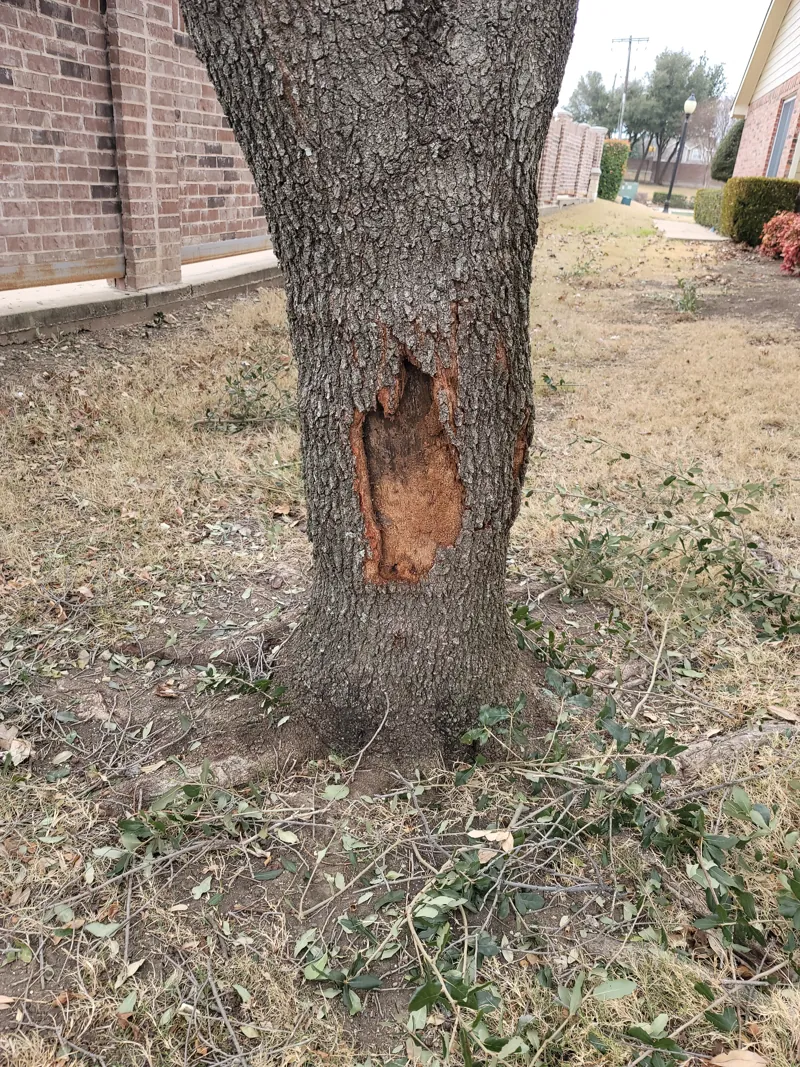
An open wound low on a tree trunk where the bark is missing and the wood underneath shows
An old wound that never closed. This one most likely started as mechanical damage low on the trunk. The bark never grew back over it, so the wood underneath has been sitting exposed, and an open wound is often where decay gets in.5
Real Arborwise™ North Texas tree work.
One young tree, three looks

It looked healthy from the street

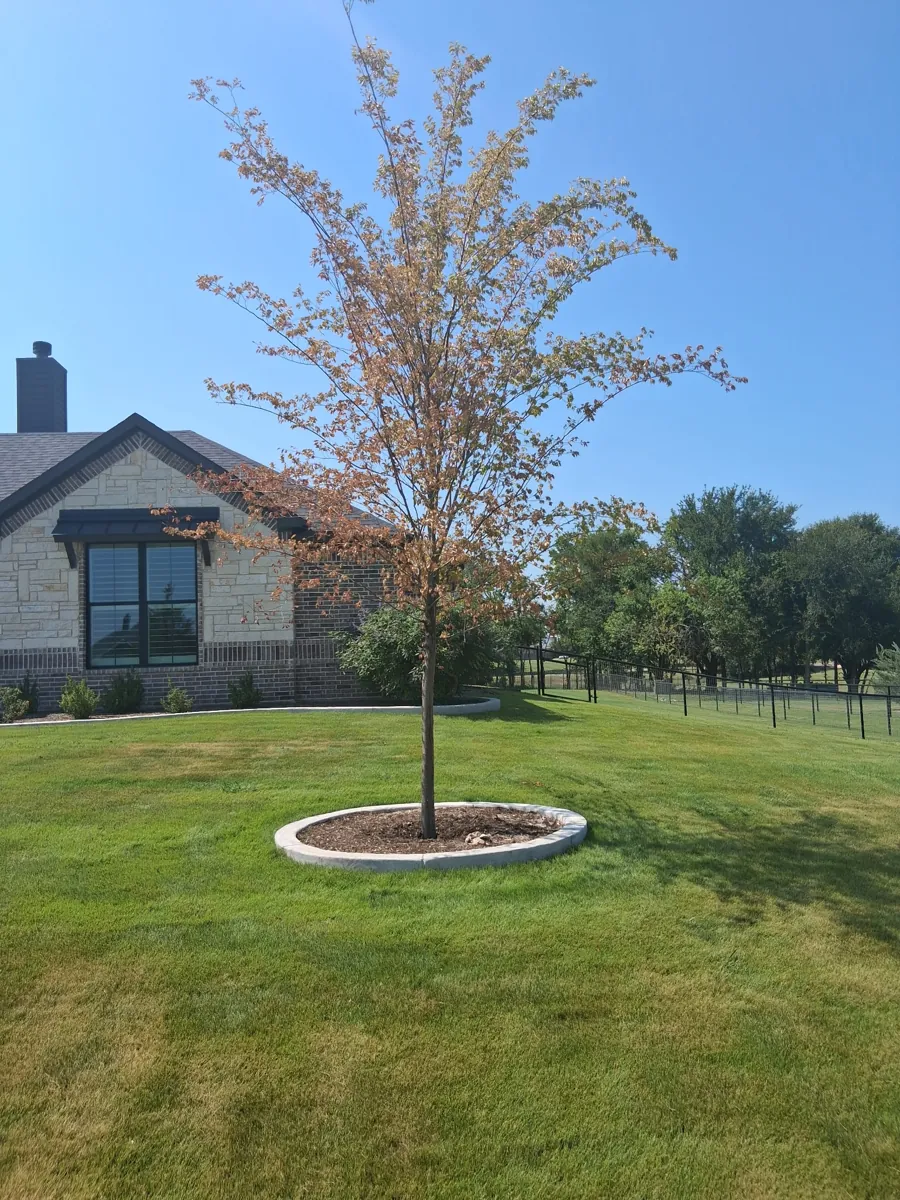
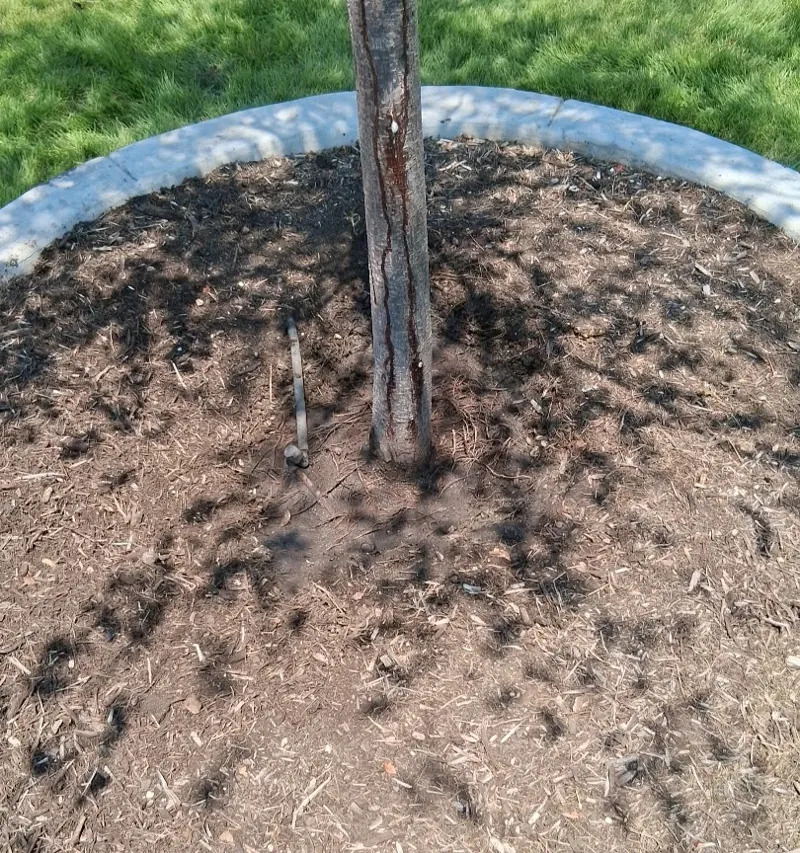
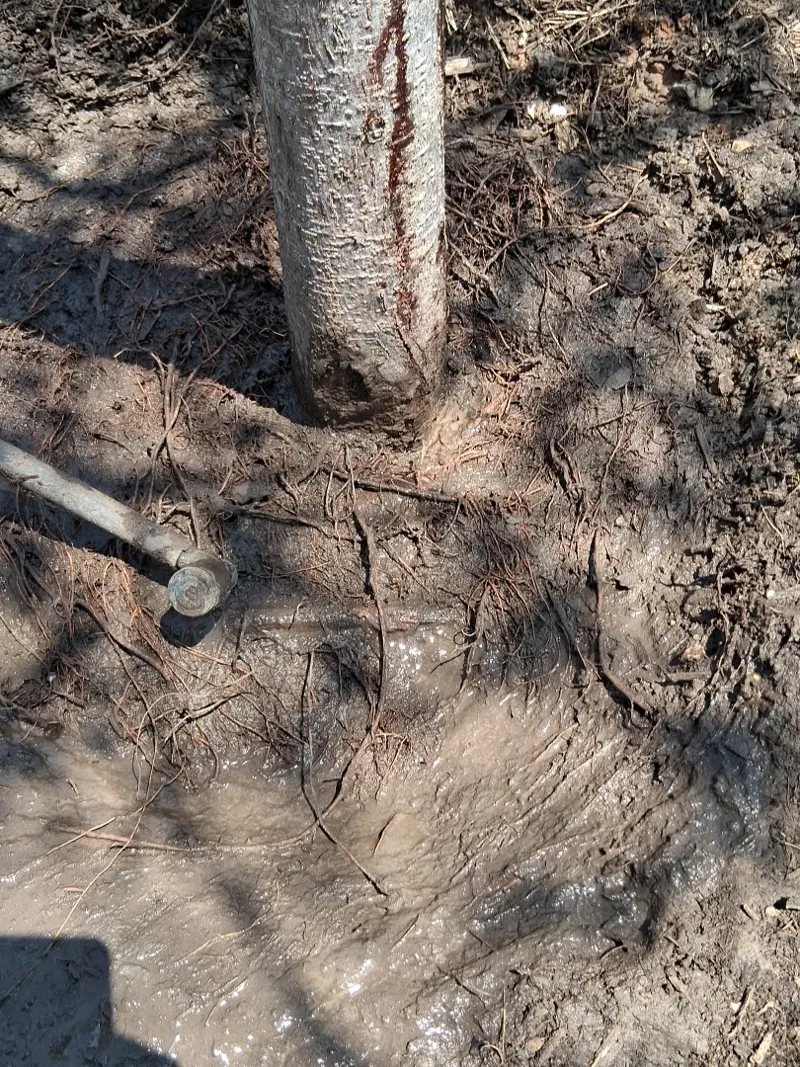
The real story was underground: this young tree's root flare sat so deep we couldn't find it. From the curb you'd see a nice tree in a tidy bed. Up close, the trunk goes straight into the ground like a telephone pole, with no flare at all. That's the kind of thing that happens mistakenly or unknowingly at planting, and it's exactly what a walkthrough is for.

A young tree in a round concrete-edged bed in a front lawn, with a thin, browning canopy
From the street. A young tree in a clean bed. The browning canopy is the first hint something's off.
Looking down at the same young tree, its trunk going straight into the mulch with no flare
Standing over it. The trunk disappears straight into the mulch. A healthy tree widens out at the base.6
Close-up of the base of the young trunk with mulch pulled back, still no root flare visible
Mulch pulled back. Still no flare. It was buried so deep it couldn't be found.
Annie, the Arborwise owl

Wondering if something like this is going on with your tree? My tree check walks through what you're seeing in a few quick questions, takes your photos, and gets it all straight to our team. Most of the time that's the fastest way to get real eyes on it.

Try the free tree check →
Common questions

Hollow trees, scrapes and rings

Can a tree live with a hollow trunk?

Often, yes. The center of a trunk is heartwood, older wood that isn't moving water anymore.1 Trees don't heal decay. They wall it off, and the cambium keeps adding new wood on the outside every year.4 Alive isn't the same as safe, though. Decay weakens the wood it's in.5

Can the decay inside a tree be stopped?

Usually not. It can sometimes be slowed, and the best help is usually supporting the tree's own work of walling it off.12 Whether a hollow tree is safe to keep mostly comes down to how much sound wood is left around it, how big and exposed the canopy is, and whether the tree is healthy and upright.12 That's a call worth having 20+ years of North Texas tree experience make in person.
What happens if bark is stripped all the way around a tree?

That's girdling. When the bark, inner bark and cambium are cut through all the way around, food from the leaves can't get down past the wound, and the tree can't grow new tissue across it. It can kill the tree.3 Mowers and string trimmers can do it,7 and so can rabbits, deer and some beetles.3

Will one mower scrape kill a tree?

One scrape on one side isn't girdling. If the damage is shallow and the cambium underneath survives, the tree can sometimes grow new inner bark there.3 Bark knocked off at the base can still seriously injure a tree, though,7 and an old wound is often where decay gets in.5

How can you tell how old a tree is?

Trees generally grow one ring each year,8 so counting the rings on a stump gives a close age. On a living tree, researchers pull a small core sample instead of cutting it down.8 Each ring's width also records that year's weather: wide in a good year, narrow in a dry one.1

The Arborwise™ way

A scrape or something more?

Most of the time, you can't tell from the yard whether a wound at the base is a scrape the tree will seal off or damage working its way around the trunk. Hollows are the same: what matters is how much sound wood is left around the decay, and that's hard to judge from the outside.5 Tree work can go wrong fast, and that's exactly why it pays to have 20+ years of North Texas tree experience look at it before anyone decides anything.

We're happy to answer any and all questions during the free walkthrough, before work starts, during appropriate work stoppages, and after the work is complete.

Get a free estimate → Photos welcome. Our estimate form takes up to six. Not sure it needs a visit yet? Send us a picture, we'll tell you what we see.
Sources
  1. Texas A&M Forest Service. How Trees Grow. Trees of Texas.
  2. Texas A&M Forest Service. Tree Trails, Module 4: Tree Structure and Function.
  3. Thompson, M.Y. (2018). Grape Girdling for Sweetness Is Different than Tree Girdling for Demise. New Mexico State University Extension, Southwest Yard & Garden.
  4. Shigo, A.L. (1985). Compartmentalization of Decay in Trees. Scientific American 252(4): 96–103. Hosted by the USDA Forest Service.
  5. McLean, D.C., Koeser, A.K., Northrop, R.J., Hasing, G. (2014). Is My Tree Safe? Recognizing Conditions that Increase the Likelihood of Tree Failure. UF/IFAS Extension ENH1246.
  6. Forehand, D. (2018). Gardening Tips: Trees and Your Root Flare. Dallas Arboretum and Botanical Garden.
  7. Dieter, C. (2012). Mulch Protects Trees from Damage. TreeFolks, Austin, Texas.
  8. Votteler, T. (2007). Reading the Rings. Texas Parks & Wildlife Magazine.
  9. Minnesota Department of Natural Resources. Reading Stories in Tree Rings. All About Minnesota's Forests and Trees, Appendix Three.
  1. Bonkowski, J. (2022). Stem Girdling Roots. Purdue Landscape Report, Purdue University.
  2. Sjolander, S.A. (2023). Girdling Roots: To Cut or Not to Cut. Penn State Extension.
  3. Bond, J. Evaluation of Trunk Cavities. UMass Amherst Urban Forestry fact sheet.