
Established 2019
A root big enough to lift concrete is usually a structural root, and cutting it is not a small decision. There is usually a way to deal with the trip hazard without taking the root.
People picture a tree's roots as a mirror image of the crown going deep. On most trees around here, the roots that hold it up and feed it run wide and shallow, mostly in the top foot or so of soil. That is why they end up under sidewalks and driveways, and why cutting one close to the trunk can take away more than it looks like.
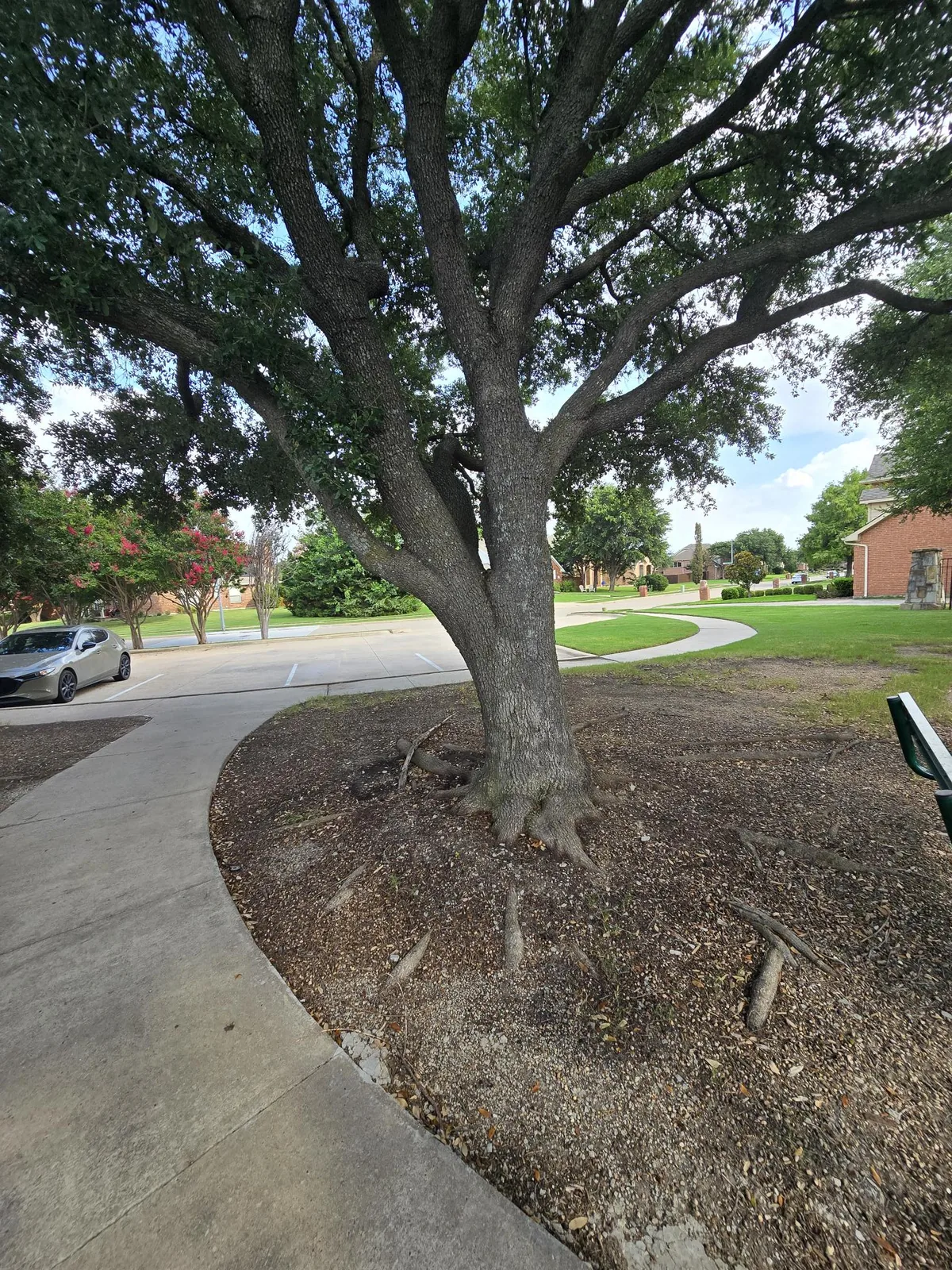
A root that is lifting a walk is doing a job. Cut it and the tree loses part of its anchor on that side, and part of its water supply. Cut enough of them and a tree that was never a problem can become one in the next storm.
Foundations are a different conversation. In this part of Texas the clay shrinking and swelling under a slab does far more damage than roots pushing on it. Roots can play a part by drying the soil out on one side, but cutting roots close to a trunk to protect a slab can trade a foundation problem for a stability problem.
 Texas A&M Forest Service on what cutting roots does to a tree
We would look at how much of the tree that root represents before anyone puts a saw near it, then look at the options that leave it in place.
Sometimes the right answer is to prune the root and it is fine. Sometimes it is to leave the root and fix the concrete. We would rather tell you which than guess.

Arborwise Tree Check walks you through what you can actually see and helps narrow down what deserves attention. Estimates are free and we love talking trees.